
About
Our school
A two-storey building with spacious halls and bright classrooms, a football pitch, a garden — and 29 years of history.
Historical background
The history of the lyceum
From 1978 the village of Oleksandrivka had only three primary classes in an old building. Older children studied in Odesa, and their parents waited many years for a new school in the village.
The new Oleksandrivka school of levels I–III welcomed its first students on 1 September 1997. Its first principal was Mykola Saltanovskyi. Later the school was headed by Mariia Kamnieva, who had worked for many years as a teacher at the Oleksandrivka primary school. The school was then led by Volodymyr Lesko until 2011.
Since 1 February 2011 the school has been headed by Tetiana Pyndak.
Timeline
Key milestones
-
1978
Primary school
Only three primary classes operate in the village, in an old building.
-
1997
A new school
On 1 September the new school of levels I–III welcomed its first students. Its first principal was M. Saltanovskyi.
-
2011
New leadership
Since 1 February the school has been headed by Tetiana Pyndak.
-
2026/2027
Today
384 students in 21 classes, 38 teachers, and free hot meals for everyone.
Facilities
What our lyceum is like
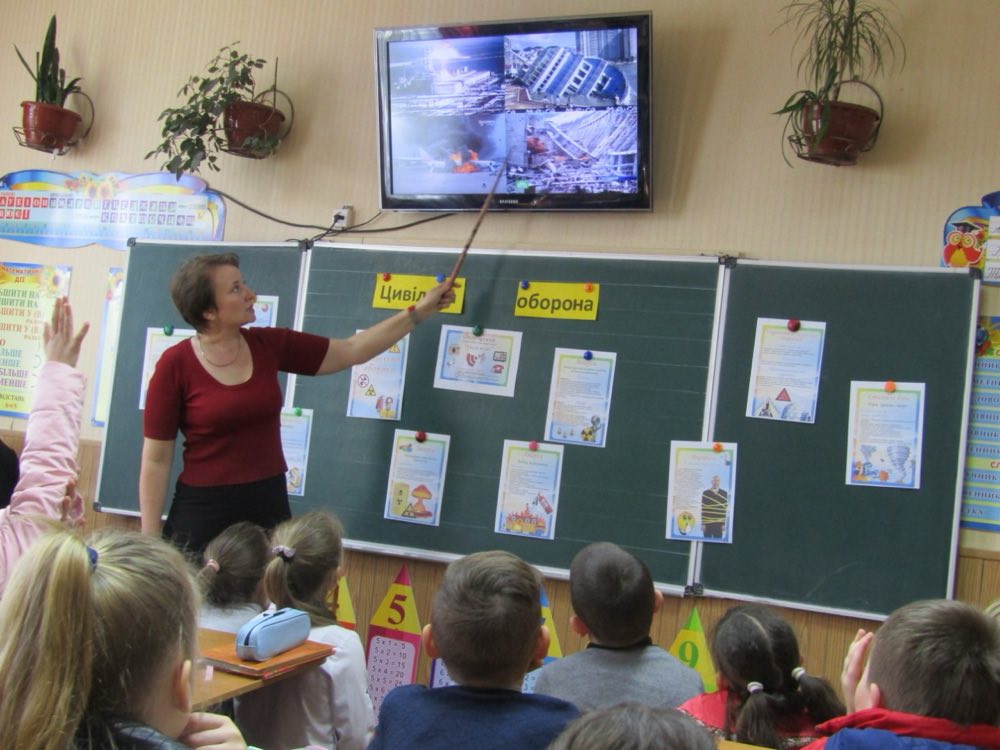
Oleksandrivka school is a two-storey building with spacious halls and bright classrooms equipped with everything needed for children to learn and teachers to work.
The ground floor houses the primary classrooms; the first floor holds subject rooms: mathematics, physics, chemistry, geography, history, English, Ukrainian and a computer lab. The school has a library and a teaching-methods room, a canteen and a medical room, an assembly hall and two gyms.
The premises are bright, furnished and equipped to modern teaching standards and connected to the Internet. The school has its own gas boiler house. The grounds — a football pitch, a playground and a garden — have become a favourite place for children and many villagers.
In 29 years the school has become known for the strong knowledge of its students and the professionalism of its teachers. It is the only social and cultural centre of the village and therefore holds an important place in the life of every resident.
The lyceum in numbers
Information about the school
What else is worth knowing
Governance structure
The school’s work is organised by governing bodies that take into account the needs of all participants in the educational process.
Read moreAcademic calendar
Defines the dates of semesters, classes and holidays for each academic year of a given educational programme.
Read moreInclusive education
Education of students with special educational needs who join the general learning environment.
Read moreInformation record
Licensed capacity and the actual number of students and teaching staff.
Read more